
British far-left organiser received hundreds of thousands from China-based tycoon
American organisations linked to Neville Roy Singham and a Chinese lobbying firm have channelled at least £250,000 to a British company linked to CCP-friendly activism in the UK

Over the past few years, outlets from across the American political spectrum have published a series of investigations into a network of leftist organisations funded by organisations linked to Neville Roy Singham, a China-based pro-Communist American technology tycoon. The funding and network are now being investigated by a grand jury in the United States, and by a House of Representatives committee.
UK-China Transparency today publishes research on Pomegranate Global Ltd. (‘Pomegranate’), a “media representation services” company based in London. The company has received at least £250,000 in declared funding from the network of American entities reportedly distributing Singham’s money.
Pomegranate’s owner and sole director, Suzanne Mondana Gilbert, is involved in a wide-range of far-left activity in the UK, including movements or campaigns promoting peace with Iran, the removal of British bases from Cyprus, and a policy of ‘no cold war’ with China. The activity consists of publishing, broadcasting, lobbying, petitioning, physical protests and the organising of other events. Gilbert visited China in 2025.
Pomegranate is a private company. It did not respond to UKCT’s request for comment, and has not shared information about how it has spent the money from Singham’s organisations. After UKCT sent a letter to its registered address, a £2 million townhouse next to Primrose Hill that is associated with Gilbert, the company changed its registered address.
This blog also investigates a Chinese company, Shanghai Maku Cultural Communications Ltd (上海马酷文化传播有限公司), linked to Singham and his networks, as well as two of its staff: Jie ‘Jeff’ Xiong 熊节, a Liverpool University alumnus and technologist; and Weiyan Zhu 朱伟燕, supposedly a lawyer. Zhu and Xiong have travelled extensively - in countries such as Brazil, Argentina, Morocco, Ghana, Cuba, and Japan. Evidence compiled by UKCT suggests they are working with Chinese officials, promoting ‘anti-imperialist’ movements in rural regions of developing countries, and lobbying for business links with China in the health, media and agriculture sectors of those countries.
UKCT’s analysis of the pair’s activities suggests a deeper level to the Singham network than previously reported: that it is involved in state-linked efforts to promote Chinese Communist Party (‘CCP’) interests in developing countries.
Lifting the curtain: accumulating concerns about Singham
Neville Roy Singham is alleged to be spending tens of millions of dollars funding pro-CCP and anti-American “propaganda” worldwide, primarily through grants by American non-profits and foundations he allegedly controls. Some of the main investigations into Neville Roy Singham to date include:
An Indian criminal investigation, beginning in roughly 2020 and hotly contested by Indian press freedom organisations, into an outlet called NewsClick, which allegedly received funding from Singham’s networks.
An investigation into Singham network organisations’ stance on ethnic cleansing in Xinjiang, published by the New Lines Magazine in 2021 and investigated further that year by China-focused outlets such as Bitter Winter.
An investigation by the New York Times published in 2023, referring to the Singham network’s promotion of a “global web of Chinese propaganda”. It also featured a photograph found online of Singham taking part in a “Chinese Communist Party International Image Communication Innovation Forum” aiming to improve the CCP’s image abroad.
An investigation by the Network Contagion Research Institute in 2024, which charged the Singham network with supporting “social unrest” on American campuses and of having “ties to extremist groups that embrace a violent,
single-state resolution to the Israeli-Palestinian conflict”.
In late 2025, the US’s House Committee on Ways & Means began an investigation into the Singham network.
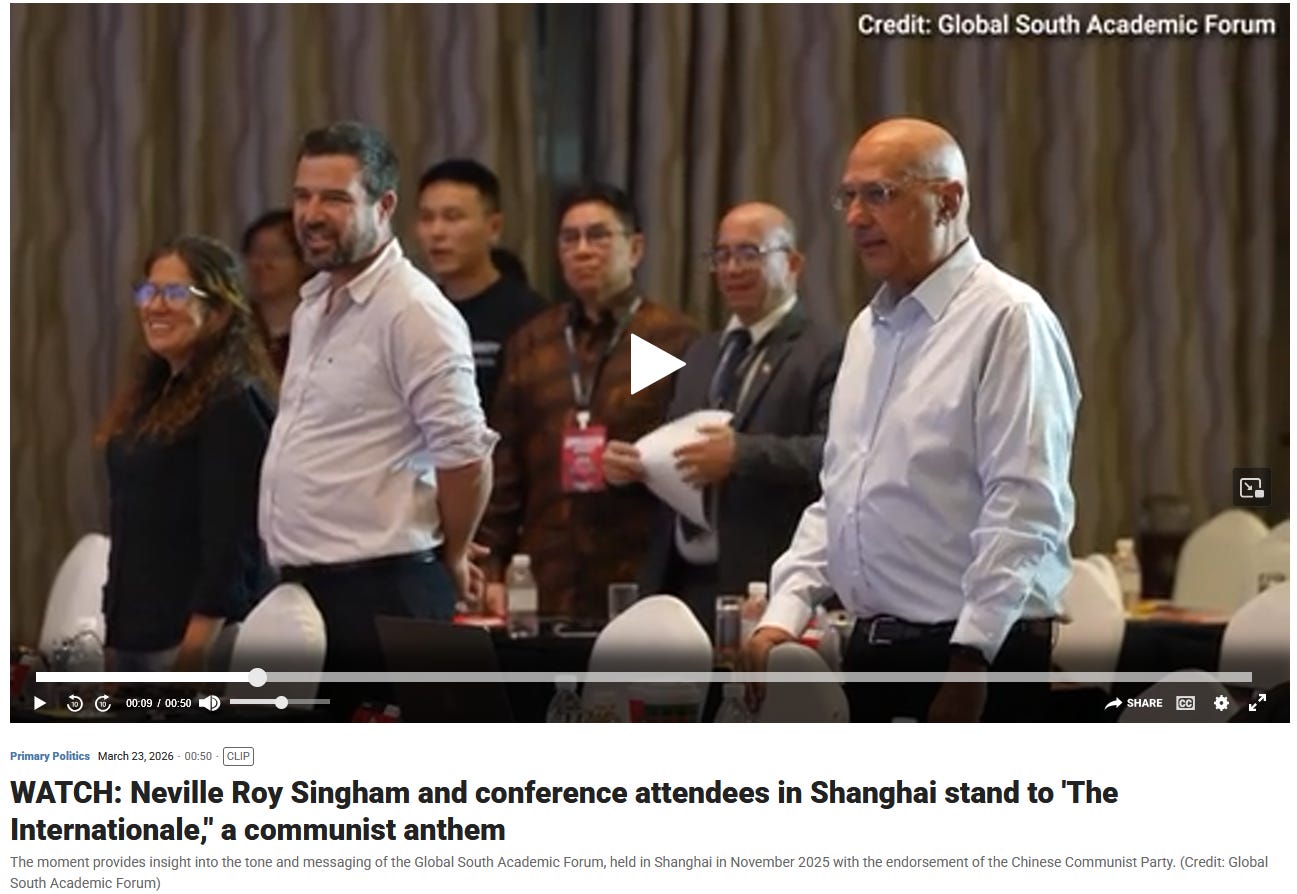
In early 2026, a multi-part Fox News investigation into the Singham network was published. The investigation mapped more than 50 funded organisations with overlapping personnel, and nearly $300 million of funding channelled through a complex apparatus - involving Goldman Sachs as a middleman, until that relationship was terminated in 2024 - and ultimately deriving from two Shanghai-based entities controlled by Singham. Organisations funded by Singham in turn have co-organised events or otherwise collaborated with thousands of other groups. (Click for links to parts one, two, three, four and five; screenshot from part 4 shown below.)
In summer 2026, the US Department of Justice launched a financial investigation into the Singham network.
The fruit with a thousand seeds: Pomegranate Global and the UK footprint
Fox News parsed documents submitted by two US-based non-profit organisations that each derived 92% of their combined $256 million funding from Singham entities: the People’s Support Foundation Ltd., and the Justice and Education Fund Inc. It is not clear from their investigations whether Fox News also had access to documents linked to Goldman Sachs.
UKCT’s analysis of the official filings (sample below) of these two organisations revealed the existence of a UK-based recipient organisation, Pomegranate Global Ltd.
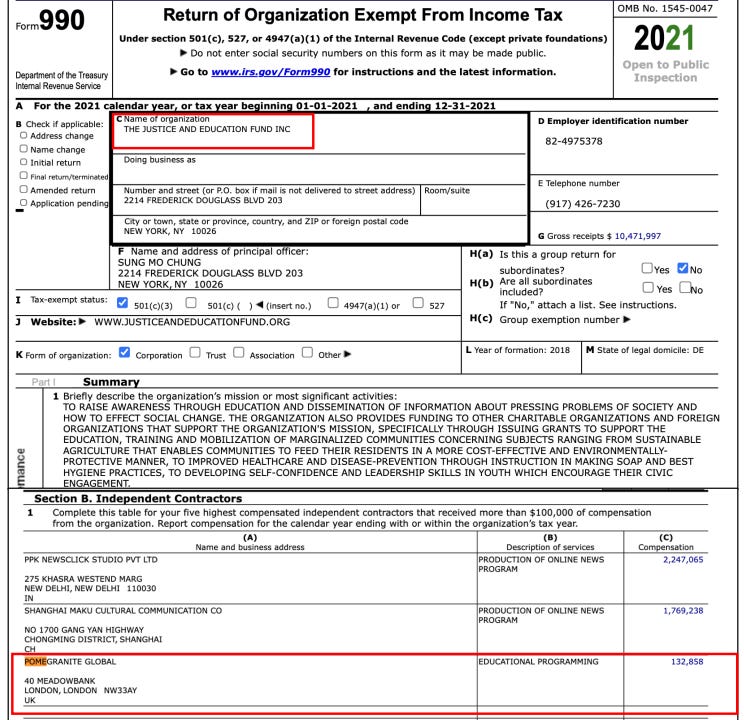
The sole director and controlling shareholder of this company is, according to Companies House, Suzanne Gilbert. According to the accounts of the Singham-linked US-based non-profits, Pomegranate has received more than $354,000, or more than £250,000, in three installments since 2020. One of the US non-profits has to declare sums over $100,000, the other must declare sums over $50,000. Singham’s grant-giving non-profits have distributed more than $20 million to European entities since 2017, without declaring with precision all recipients of this money. These two facts combined suggest that there may be further (sub-reporting threshold) payments to Pomegranate, although UKCT has no evidence of this.
Suzanne Gilbert used to work for the firm through which Singham made his millions, Thoughtworks, and is also known as a film producer for her work with Oliver Stone on “Castro in Winter”, and on the feature film “W.” about George W. Bush. In 2012, she was described by a Pakistani newspaper as an American peace activist living in Hollywood.
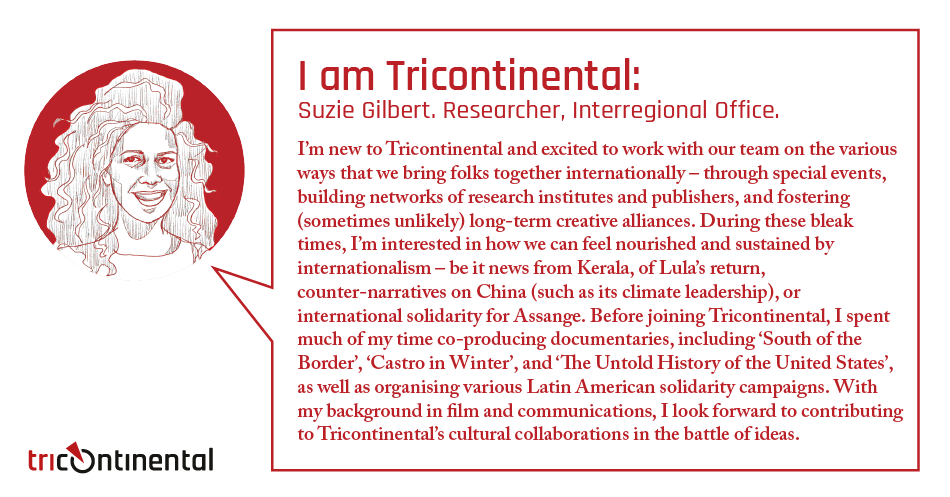
Gilbert was referred to in 2021 (see image below) as involved with the Tricontinental Institute for Social Research, which has branches in various countries and describes itself as “part of an international process to create a network of dozens of research institutes”. Singham is Tricontinental’s International Advisory Board’s chair and the organisation is reportedly funded by him.
Gilbert has also described herself as an organiser for No Cold War Britain, the UK branch of an international movement, No Cold War, organised by a “collective” that includes other Tricontinental staff along with socialists and avowed communists from around the world. No Cold War Britain’s Facebook page mainly reposts content from this collective. A linked podcast is run by the group’s co-organiser, Fiona Edwards, and Ileana Chan, who also hosts another podcast, Empire Watch. Both podcasts consistently recruit guests from the Tricontinental/Singham network, and have been promoted by Tricontinental.
In 2021, No Cold War Britain co-organised, along with organisations linked to the CCP’s United Front, a London rally ‘against racism towards East Asians’ at which anti-CCP demonstrators from Hong Kong were violently attacked by a group including a convicted people smuggler, an ally of the Chinese embassy previously pictured with Xi Jinping, and a pseudonymous individual referred to in a recent criminal case at the Old Bailey as a member of the 14K triad. UKCT will shortly publish separate research about this incident. There is no suggestion that No Cold War Britain were aware of the identities of these participants in their rally.
Gilbert and her activism in the UK are also associated with US-based group, Code Pink, which is run by Singham’s wife and which received roughly a quarter of its funding from Singham non-profits in the period 2017 to 2023, according to the New York Times.
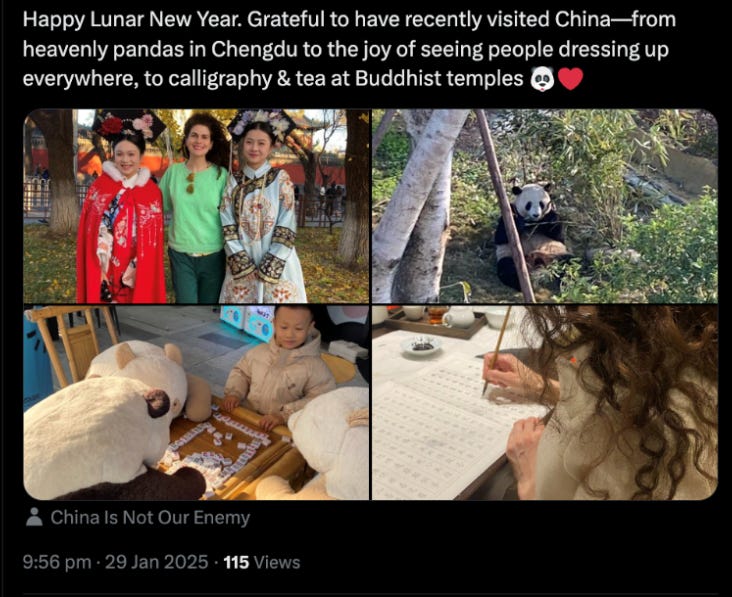
In January 2025, Gilbert indicated in a post on X/Twitter that she had recently visited China, writing of “the joy of seeing people dressing up everywhere”. (See screenshot below). Other social media posts indicate that this was part of a trip organised by Code Pink “to prove that China is not our enemy”.
UKCT has non-exhaustively mapped Gilbert’s involvement in chairing or organising other events in the UK, including events in “solidarity” with Venezuela, against ethnic cleansing in Palestine, and against the US and British militaries.
Pomegranate did not respond to communications from UKCT in advance of the publication of this article.
Maku: "surrounding the city from the countryside"?
It has been widely reported that Singham is based in Shanghai and there shares an office with a Chinese company called Shanghai Maku Cultural Communications Ltd (‘Maku’, 上海马酷文化传播有限公司), a company supposedly dedicated to building links between China and developing countries.
There is indeed evidence of organisations in the Singham network, such as the Tricontinental Institute, using the Maku office (UKCT can share its archived open-source evidence on request), and of Maku receiving millions of dollars in funding from Singham non-profits. Moreover, Maku’s staff are all involved in Singham-linked initiatives and organisations.
In its survey of the existing reporting about the ‘China side’ of the Singham network’s operations, however, UKCT identified a lack of treatment of Chinese-language material and no high quality Chinese source-based research on Maku staff, who have been assumed to be involved with the Chinese Communist Party given the strict rules around media and research activity in China, especially that involving foreigners.
The following paragraphs outline a very superficial survey of the activities of two of the three staff who initially appeared on Maku’s website and appear as the company’s shareholders in English translations of its corporate filings that have been published online: these are Jie ‘Jeff’ Xiong 熊节 and Weiyan Zhu 朱伟燕.
Jie Xiong has been repeatedly described as an MBA alumnus from Liverpool University. He is a former employee of Singham’s tech firm, Thoughtworks, where he reportedly consulted for Huawei and and other clients in the “finance, retail, government, telecommunication, and logistics industries”. Xiong is listed as a writer for the Tricontinental Institute and a Secretary-General of the Global South Academic Forum, which convenes Marxist academics from all over the world in China.
An academic paper published by Xiong sheds some light on the possible significance of his work in technology. In an article published in 2025, Xiong describes “American Big Tech’s digital hegemony” and argues:
“…that effective resistance to digital hegemony requires alliances between the state and non-co-opted segments of civil society. The analysis extends to the Global South… […] since 2016, the Chinese government has placed political limits on domestic Big Tech, implemented people-centered regulatory policies, and maintained sovereign control over its digital space. While not without its contradictions, this model demonstrates that a state–society alliance can achieve tangible results in countering the Empire’s digital power… […] overcoming digital hegemony requires moving beyond spontaneity-based paradigms toward structured, state-supported strategies - particularly in the Global South - capable of addressing the political-economic foundations of Big Tech’s global dominance.”
Xiong appears to be involved in some work with or adjacent to the Chinese government. This is evident in respect of Ghana, for example. In January 2026, Maku was referenced in connection to a visit by Ghanaian officials to Beijing: the visit was “jointly coordinated with Shanghai Maku Cultural Communication Company Ltd” according to an official Ghanaian press release.
Queries using key terms such as “people-to-people”, “China”, “Ghana” and exchange quickly yielded evidence of other Maku activity in Ghana. In 2025, Xiong was photographed as part of “a Chinese delegation led by Deputy Ambassador Li Yang [which] paid a courtesy call on Ghana’s Vice President, Prof. Naana Jane Opoku-Agyemang, to strengthen diplomatic ties between the two nations.” These reports would appear to situate Maku and Xiong personally in a quasi-official space, close to the Chinese state.
Other evidence points to Maku also funding activity in Ghana’s civil society sector. Weiyan Zhu, one of Maku’s other shareholders and staff, is described online as “coordinator of the International Association for Popular Cooperation (IAPC)”, elsewhere described as “IAPC-Baobab”, which describes itself as “an international non-profit association that promotes cooperation in science and technology among the peoples of the various communities of the Global South, with the aim of social and agro-ecological development”, that is “registered in Switzerland and [has] offices in Asia (Beijing), Latin America (São Paulo) and Africa (Accra).”
Two Ghanaians based in Accra/Beijing describe themselves as IAPC staff on LinkedIn. The organisation’s authorised representative is another individual associated with the Singham network. UKCT could find no direct evidence that Singham is the source of the group’s funding, however, its funding is not described online.
IAPC’s website makes clear that it lobbies for China-Ghana ties. There is reference to it devising a plan for “a Memorandum of Understanding (MOU) on cooperation in fisheries and aquaculture between the fisheries authorities of China and Ghana”, and associated bilateral mechanisms.
Both Xiong and Zhu are involved in other activity focused on rural organising in developing countries. UKCT did not conduct a comprehensive survey, but identified, for example, Zhu’s and IAPC’s involvement in a Chinese delegation to an agricultural region of Brazil in connection to an agreement to source Chinese agricultural technology.
Indeed, IAPC’s website specifically refers to the organisation co-developing “an artificial intelligence system launched at the 14th National Meeting of the MST [Landless Workers’ Movement of Brazil]: ‘The fight against imperialism is central today’ … the AI can address everyday issues, such as controlling aphids or designing agroforestry systems, as well as produce in-depth studies on the role of agroecology in building class consciousness from a Marxist perspective.”
UKCT only conducted a brief survey of Maku activities, and yet this appears to have yielded evidence of its:
Cooperation with Chinese official organisations.
Obscure involvement in ‘civil society’ organisations in the West and the developing world.
Promotion of Chinese business interests in the developing world.
Promotion of an ‘anti-imperialist’ rural movement in the developing world.
There is clearly scope for deeper research into the Singham network, its cooperation with Chinese official entities, and activity around the world…