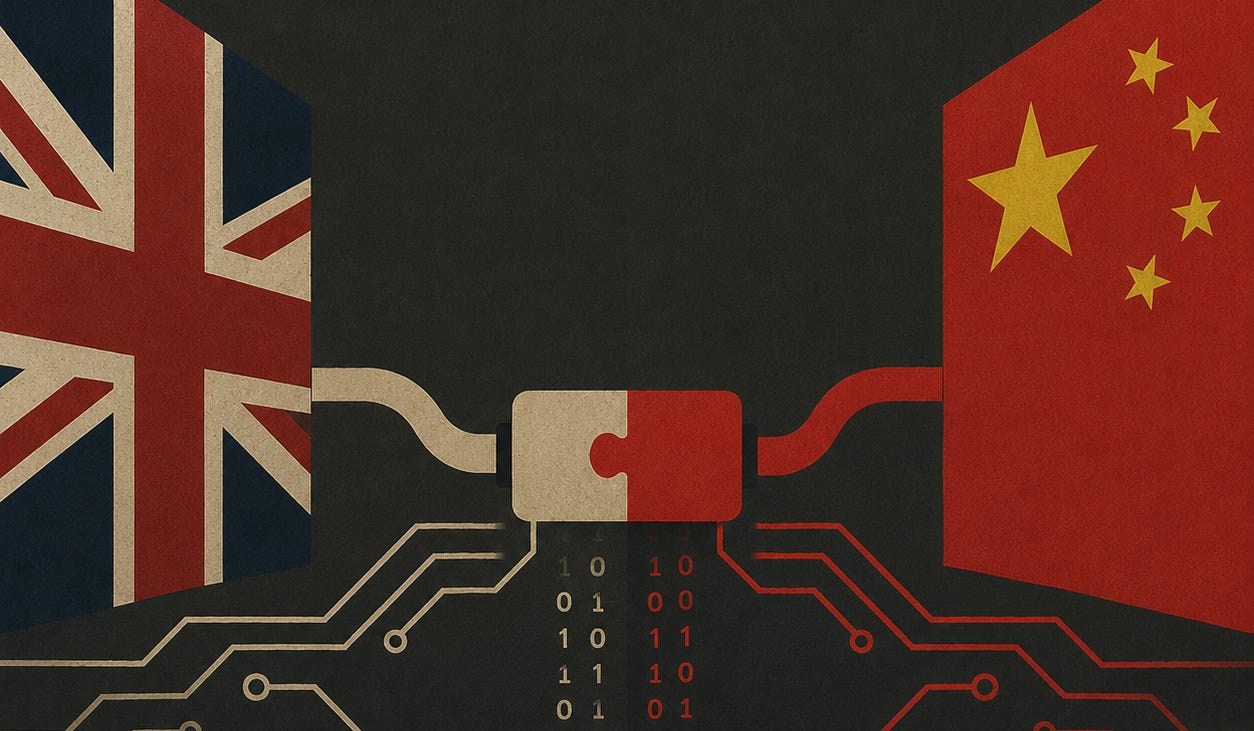
'One Network, Two Systems'
UK-China Transparency publishes major new report exposing research security risks in UK/China university cyber partnerships

UK‑China Transparency (UKCT) has released ‘One Network, Two Systems’, a landmark investigation revealing that the UK maintains more cyber‑related university partnerships with China’s defence‑linked institutions than any country in Europe, including extensive collaborations with universities authorised to conduct classified weapons research.
Considering the growing record of Chinese state cyber hostility against the UK, this is a remarkable finding. British organisations spend billions of pounds countering this phenomenon.
The report identifies 34 UK/China partnerships in cybersecurity, computer science, and telecommunications, nearly matching the total across all 27 EU member states. Thirteen of these involve Chinese universities embedded in China’s defence research system, including four institutions holding Top Secret military research clearance.
“Some of these partnerships involve Chinese institutions deeply embedded in China’s defence research system, creating structural risks that the UK’s current research security framework is not designed to address.” (Report)
Key Findings
1. UK universities are exceptionally structurally exposed to China’s defence research ecosystem. The report documents that the UK has more Chinese government-registered partnerships with China’s highest‑risk defence universities than any other country – the “Seven Sons of National Defence” plus Beijing University of Posts and Telecommunications (BUPT), all of which are authorised to conduct classified weapons R&D – than any other country globally (including Russia).
2. There is deep operational integration between Chinese partner universities and the PLA. Case studies of BUPT and Beihang University reveal direct collaboration with the People’s Liberation Army, defence‑industrial conglomerates, and intelligence‑linked entities. Faculty profiles show recurring patterns of classified funding, redacted project titles, and research applied to PLA cyber, aerospace, and electronic‑warfare scenarios. “Analysis of over 100 BUPT and nearly 80 Beihang faculty profiles reveals recurring patterns: explicit military or defence‑aligned funding… and connections to intelligence agencies including the Ministry of State Security.” Moreover, during the period of research of UKCT’s paper, information relating to defence work was removed from some faculty staff profiles, raising questions about deceptive behaviour and the limits of open-source due diligence.
3. UK partnerships are deeply institutionalised, and are expanding. The most extensive collaboration, the BUPT/Queen Mary University of London Joint Education Institution, has produced more than 9600 dual‑degree graduates and generated 465 co‑authored computer‑science publications. Many BUPT faculty involved in this collaboration simultaneously conduct defence‑designated research. Nearly half of all UK cyber partnerships with China were established since 2020, indicating rapid expansion despite rising security concerns.
4. UK research security mechanisms appear insufficient. The report finds that the UK’s current framework (including Trusted Research, RCAT, and ATAS) remains advisory, fragmented, and focused on individuals rather than institutions, leaving major structural risks unaddressed. The paper also includes evidence of defence work and affiliations removed from academic profiles in China, attesting to the limits of due diligence based on open sources and trusted inquiry, and some efforts to conceal military connections.
5. Other countries have already acted. The USA, Canada, Taiwan, the EU, and several European universities independently have imposed categorical restrictions on partnerships with China’s defence‑linked universities. The UK has not.
Policy Recommendations
UKCT has not historically proposed policy recommendations, its usual practice being to set out the evidence and to allow policy makers to draw their own conclusions. However, on this occasion we have allowed the report’s author, Eugenio Benincasa, to propose five targeted reforms himself:
Establish a UK Named Research Organisation List modelled on Canada’s approach to identify high-risk institutions and guide restrictions on grants and institutional partnerships, including joint programmes and co-supervised doctorates.
Mandate research security officers at universities engaged in high-risk partnerships to oversee such partnerships, supported through access to government threat briefings and specialised training.
Address financial dependency through relief funding to enable institutions to terminate or restructure high-risk partnerships and to prevent viable research projects from being blocked due to concerns about high-risk partners or funders.
Encourage pre-travel security briefings and post-travel reporting for staff engaged in China-related teaching, supervision, and partnership management.
Maintain balanced and consistent messaging, clearly communicating that research security is about targeted risk management, not blanket restrictions on collaboration with China.
Author’s Comment
Benincasa said “the UK’s research security architecture has not kept pace with the scale and structure of university partnerships with China. This report shows that the risks are systemic, not incidental, and that other countries have already moved to address them. The UK appears to need a coherent, institution‑level response.”
The full report is available to read on Google Drive here or can be directly downloaded below.