
Study exposes Chinese organised crime threat in the UK, state links, and student involvement
Police officer David Wilson's PhD thesis was based on interviews with 25 investigators, analysis of police data, and a survey of more than 900 Chinese students

Dr David Wilson is a regional co-ordinator for the organised immigration crime domestic taskforce at West Midlands police and a former detective inspector. Wilson is an expert in Chinese organised crime. His PhD thesis was sponsored by the Home Office and declassified after several months in February. UK-China Transparency gained exclusive access to it and shared it with the Sunday Times.
The Wilson Report is now circulating amongst journalists and others prior to its academic publication. UK-China Transparency would be happy to share a copy of it with anyone interested.
Few people are aware that Chinese organised crime in the UK was last year described by the National Crime Agency (NCA) in its annual strategic review as probably the most serious foreign organised crime threat. A similar assessment is included in the NCA’s 2026 strategic review.
The Wilson Report is a groundbreaking moment in the study of Chinese organised crime in the UK. Nothing like it has been produced more than 35 years, as the Report’s own survey of existing literature, including police studies, indicates.
The Report states that police have observed links between Chinese organised crime groups (COCGs) and shadow economy actors in the UK and Chinese diplomats.
Key themes from the Wilson Report
—> Business models
COCG in the UK often deploy “polycriminal” business models, involving activity across multiple crime types. This may mean overlapping involvement in sexual exploitation, money laundering, drug importation, fraud, underground banking, and other activities, often using one area of offending to facilitate or conceal another.
Fujianese criminal networks have become especially prominent in the UK. Fujian is a province in China, from which a large proportion of Chinese immigrants to the UK in the 1990s and 2000s hail. The Wilson Report repeatedly references the rise of Fujianese groups and their role in illegal migration pathways, labour exploitation, and wider organised criminality.
—> Police capabilities
A central conclusion of the Wilson Report is that the police have a limited understanding of COCGs and lack the linguistic, cultural, and specialist expertise required to investigate it effectively. The thesis suggests that a failure to recruit from Southeast Asian communities and difficulties finding interpreters that have been exacerbated by instances of interpreter compromise have left forces “desperately short of language skills and cultural understanding”. Officers are resorting to Google Translate for Mandarin and Cantonese. None of those interviewed had a means of translating the Fuqing dialect of Eastern Min (sometimes referred to as Hokchia), which is used by some Fujianese OCGs in the UK.
This lack of capability, along with the often national or transnational nature of COCGs’ business models, means that local police officers are sometimes ignoring COCG activity because it is “too difficult” or “too big”. Said one officer:
“I was looking at groups doing Daigou [a tax avoidance/laundering method], working with HMRC, but it fizzled out as it was too big […] I think it was just too big for anybody to want to kind of stick their hand up and take it on.”
—> State links
The Report states that there are links between COCGs and the Chinese state. It claims that COCGs have historically possessed political dimensions and that, in the modern period, elements have been incorporated into the Chinese Communist Party’s United Front work. Said one officer interviewed:
“We have come across links between some of the more senior officials of OCGs and members of the Chinese consulate”
There is also reference to Chinese businessmen starting business associations on the encouragement or direction of the Chinese government, and individuals linked to criminality running such groups and in that capacity being pictured with diplomats. It is evident that investigating officers were not always aware of what to make of such evidence, and that police intelligence is not quite in a fit state to assess systematically the nature of these ties. The Report argues that Counter-Terror police “should maintain a national overview of all UK Chinese SOC [serious organised crime]”.
—> Students
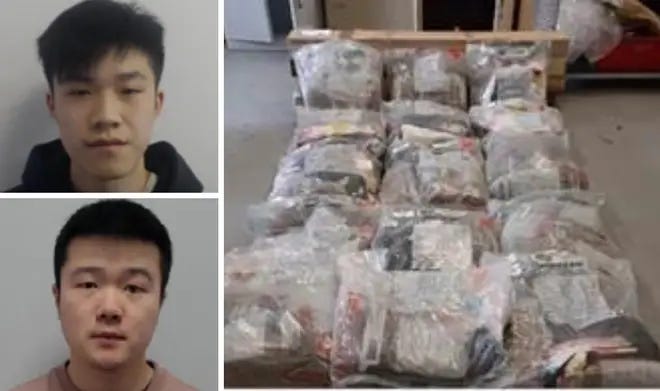
The Report observes that police investigating COCGs have repeatedly found that Chinese students are part of COCGs’ business model. It also featured analysis of the results of a survey that was circulated to more than 25,000 Chinese students. 916 replies were received. 42 (or roughly 5%) said they had been asked to engage in potentially illegal activity (organised receipt of unknown packages, bank transfers, storing illegal goods, and so on) by a Chinese person. There are roughly 150,000 Chinese students in the UK.
Upcoming UKCT research on CCP links to the shadow economy in the UK
Some of the Wilson Report’s findings chine with UK-China Transparency’s (UKCT) own research, more of which is forthcoming.
In April, UKCT published research on Lin Lihao, entitled, “The Fujianese brothel business director who schmoozed Alex Salmond, hosted a “police overseas service station”, and met with senior CCP officials”.
UKCT’s research referenced an academic article in which Lin was mentioned by name as the sponsor of a Chinese student group in Glagsow, with an anonymous former member of the group interviewed as part of the academic researching making the following claim:
“Most of the funding comes from the boss [Lin]. In exchange, the CSSA branch provides him with services and promotes his business, including illegal services. (...) His Fujianese gangsters then come to our events, sell drugs, buy drinks for the girls and harass them. (...) We tried to contact the embassy about these problems, but since he is a qiaoling [a leader of the Chinese diaspora], they can’t do anything.”
There is no allegation that Lin himself has engaged in criminal behaviour.
In the coming fortnight, UK-China Transparency will continue to publish case studies of individuals with links to crime or the shadow economy who are or have been close to Chinese diplomats and the Chinese Communist Party’s United Front Work Department.