Key points:
Beijing remains committed to subnational diplomacy in the UK, which may be under-scrutinised by the media, researchers and some parts of Whitehall
One initiative promoted by the Chinese consulate in Belfast sees Chinese Communist Party propaganda books given to schools, for example. One school provided UKCT with a list of books (see below), however, the school informed UKCT that the collection had been put into storage.
Interactions with Northern Irish police also come in the context of very limited practical cooperation from the Chinese side on Chinese organised crime in the UK, and security sensitivities
A recent, first-ever “Open Day” held by the Chinese consulate in Belfast has drawn attention to intensifying subnational diplomacy between China and Britain’s constituent regions and nations.
Beijing is making a concerted effort to strengthen diplomatic and economic ties with Northern Ireland. With legislative power over sectors which feature prominently on China’s foreign agenda, such as economic development and education, Belfast is a high-value target for Chinese subnational diplomacy. Northern Ireland may also provide Beijing with an entry point into EU markets. Naturally, the historically sensitive security and sovereignty situation in Northern Ireland may also be of interest to the Chinese state.
While China’s efforts in Northern Ireland have not gone unnoticed, media reporting tends to focus on individual incidents without piecing together the broader trend. By assessing the activities of China’s Consulate-General in Belfast, and drawing upon UK and Chinese media sources, UKCT has sought to provide an overview of Beijing’s diplomatic activity in the nation.
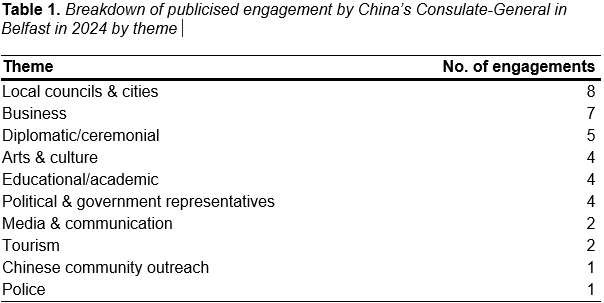
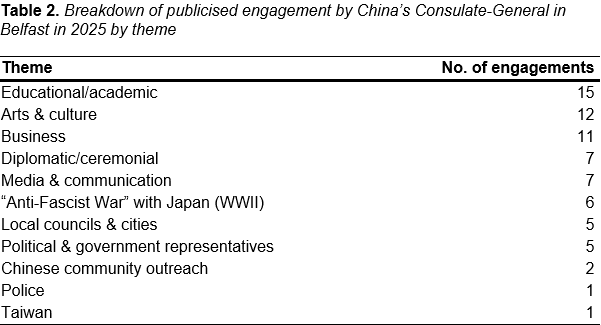
China’s Consul-General in Belfast, Li Nan 李南, has been taking an ostensibly proactive approach since his appointment in September 2024, with regular updates of official meetings and visits posted to the Consulate-General’s website. The majority of these posts are from October 2024 to March 2025, as well as a spike in the first quarter of this year, but their current frequency is still higher than in the time of Li’s predecessor, Zhang Meifang 张美芳. (It is interesting to note that Zhang is the wife of Liu Haixing 刘海星 the current head of the CCP’s International Department, on which see more below.) The posts reveal both change and continuity in the nature of the consulate’s outreach. The following analysis is based on such public posts.
During the final part of 2024, Li met more frequently with local representatives, such as city mayors and councillors, than those from any other sector. By 2025, however, meetings with local representatives dropped significantly, accounting for just 7% of consular engagements, down from 21% in the previous year.
As meetings with local representatives declined, educational and academic institutions have become the most common point of contact for the Consul-General. Interestingly, the majority of publicised visits to educational institutions involved primary and secondary schools, instead of universities (of which there are just two in Northern Ireland.) While China’s involvement in UK higher education continues to attract scrutiny, the CCP’s activities in UK schools have flown largely under the radar.
A recent initiative launched by the Consulate-General in December, called “Books into School” (图书进校园), began with visits by Li Nan to two state grammar schools in Belfast. One of the schools, Grosvenor Grammar, accepted almost 80 books as part of the Consulate-General’s initiative, including titles such as Lies and Truth on Xinjiang: Exposing the US-Led Infowar Against China, The Communist Party of China and China’s Democracy, and Rule of Law in China. UKCT received the results of a Freedom of Information request naming all the titles given to this school. It can be read here. However, in this case, the school clarified that it had not put the books in the library or made them available to students; they had instead been put in storage. The Belfast Telegraph reported on UKCT’s research into this, citing concerns from Northern Irish politicians. (UKCT may be able to share a copy of their article on request.)
During his visit, Consul-General delivered lectures to students - with an audience of nearly 200 in one case - on “China’s national conditions and culture”. According to the Consulate-General, “Li Nan introduced China in a simple and understandable way from multiple dimensions [...] helping the students gain an explicit and deep understanding of the profound spirit and contemporary value of the Fourth Plenary Session of the 20th [Chinese Communist Party] Central Committee”. Li’s introduction to China also included topics such as “governance concepts”, “achievements of Chinese modernization” and geography.
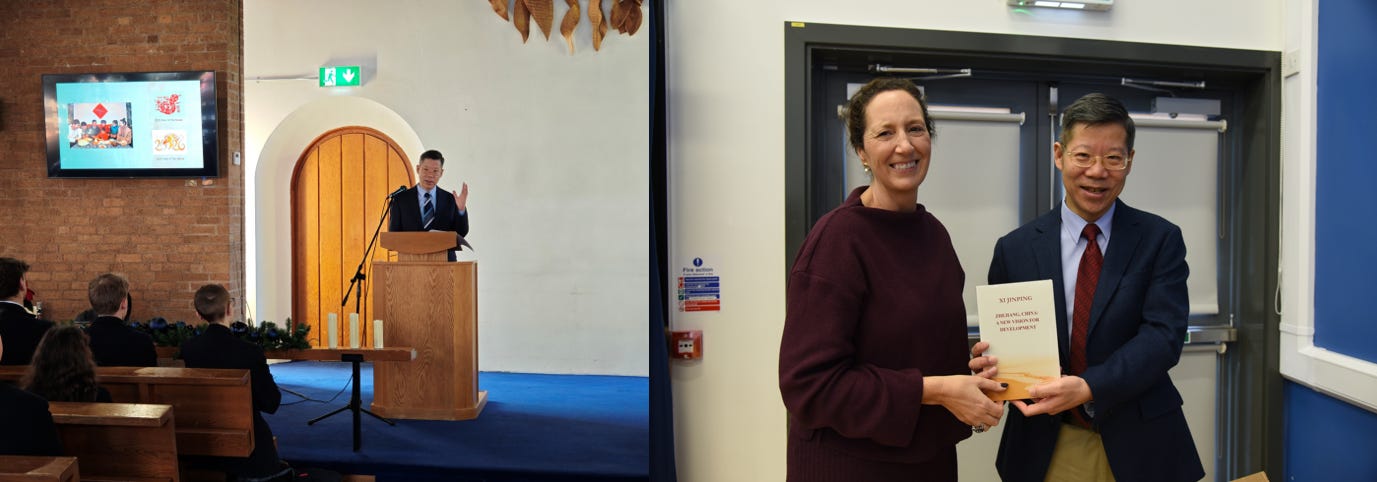
Li hosting “Books into School” events at Methodist College Belfast (L) and Grosvenor Grammar School (R). The book on the right is entitled, “Zhejiang, China: A New Vision for Development”, by Xi Jinping
As for continuity from 2024 to the present, business-related engagements appear to have remained high on the consular agenda, as illustrated by a major trade forum held in Belfast last November. The forum hosted over 350 senior representatives of governments, enterprises, and institutions from both China and Northern Ireland, including over 120 Chinese business leaders. Also in attendance was China’s ambassador to the UK, Zheng Zeguang 郑泽光, pledging new investment and trade in Northern Ireland.
Belfast’s dual access to both EU and UK markets was highlighted by both Chinese and Northern Irish attendees. Wang Tingjiang 王廷江, chairman of Thompson Aero Seating (an aeroplane seating manufacturer acquired by AVIC, a Chinese defence company, in 2016), expressed his hope to see “Chinese companies use Northern Ireland as their entry point to the UK and EU”.
A month after the forum, Northern Ireland’s economy minister, Dr. Caoimhe Archibald, visited China for a five-day program “to develop new and strengthen existing economic ties”.
The Consulate-General’s focus on business-related engagement in Northern Ireland aligns with Beijing’s outreach in the UK more broadly. A study of China’s International Department (ID; formerly known as the International Liaison Department) in Europe has shown that, in the UK, the ID (which is tasked mainly with establishing relations with foreign political parties) has prioritised meetings with senior representatives of enterprises and non-political organisations over political parties. This contrasts with Germany where the ID has had more success in engaging with political parties. UKCT intends to publish further analysis of the ID’s activities in the UK.
That being said, meetings with political and government officials have remained fairly consistent. Li held nine publicised meetings from 2024 to 2025, but has likely had many more in the margins of events which have seen political and government representatives in attendance. Nevertheless, political and governmental engagements have remained significantly less frequent than those with business leaders and educational institutions.
Official meetings with police, while not frequent, have also occurred. In October 2024, Li held a meeting with the District Commander of Belfast at Musgrave Police Station, and again in January 2025, with the Deputy Chief Constable of the Police Service of Northern Ireland (PSNI). When approached by UKCT, the PSNI chose not to comment on these meetings.
These meetings have a sensitive context, given the involvement of Chinese groups, some of which are suspected of having linkages to Chinese officials, in organised crime and shadow economy activities within Northern Ireland. Generally speaking, the nation’s trade and border situation creates a ripe environment for smuggling. UKCT’s previous work has underlined the serious issues – including linguistic issues and those relating to cooperation with the Chinese government – facing British police organisations when it comes to effectively dealing with Chinese organised crime.
In the Northern Irish context, there may be special security elements layered on top of this criminal threat. Chinese organised crime in Northern Ireland has - according to police sources and public reporting on at least one major case - featured collaboration with Irish Republican Army dissidents also involved in organised crime.
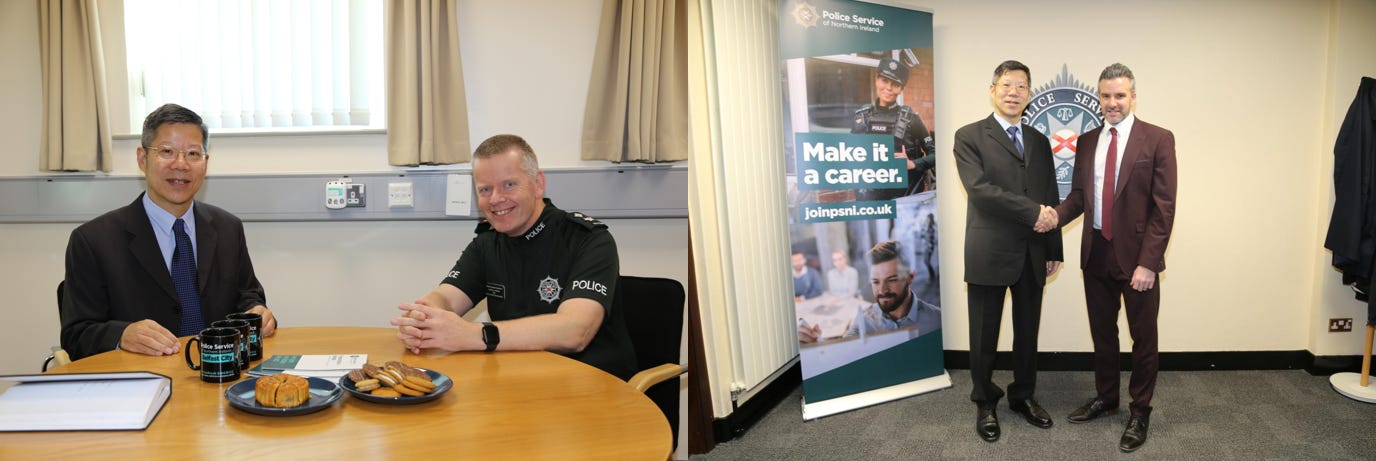
L: Meeting at Musgrove Police Station with the District Commander for Belfast. R: Meeting with Deputy Chief Constable of the Police Service of Northern Ireland.
UKCT’s analysis is published at a time when the British Government’s Foreign, Commonwealth & Development Office (FCDO) has stated its desire to encourage renewed sub-national diplomacy between British nations and regions and Chinese central and provincial governments, after the pandemic caused an enduring hiatus for such activity.